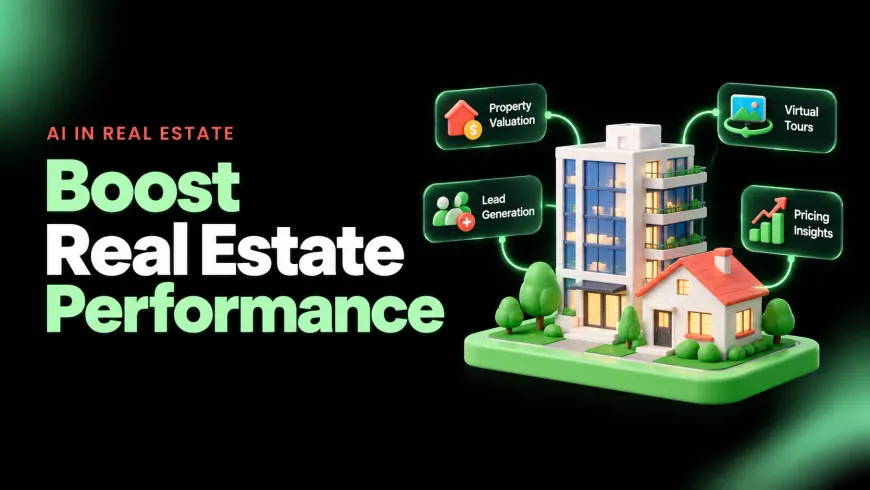
AI in real estate has moved from experiments to everyday tools for pricing, lead handling, leasing, property operations, and development planning. The firms pulling ahead are not the ones with the most pilots. They are the ones that picked a few high-volume, data-rich tasks and built AI into the systems their teams already use.
The opportunity is large. Morgan Stanley estimates that 37% of tasks at the real estate companies it analyzed could be automated, worth about $34 billion in operating efficiencies by 2030. Adoption is nearly universal, yet results lag: the JLL 2025 Global Real Estate Technology Survey found 88% of investors and 92% of corporate occupiers piloting AI, but only 5% of occupiers had achieved all their program goals.
This guide is for brokerages, property managers, investors, and developers who want AI that pays back. It covers 15 proven use cases, how agents can use AI day to day, conversational AI, benefits and risks, build-versus-buy choices, and a step-by-step rollout plan, drawing on EnactOn’s work in PropTech software development.
How Is AI Changing Real Estate?
Here is how AI is changing real estate: it speeds up decisions that used to take days, automates repetitive admin, and personalizes how buyers, renters, and tenants are served. Pricing models, lead scoring, document processing, and tenant communication are where the change is most visible today.
-
Faster, data-driven valuations. Automated valuation models (AVMs) estimate property values from sales history, listings, and local data in seconds.
-
Always-on lead response. AI assistants answer inquiries and qualify leads around the clock, so no prospect waits until morning.
-
Less paperwork. Document AI extracts data from leases, contracts, and invoices, cutting manual entry and errors.
-
Smarter building operations. Predictive maintenance and energy optimization reduce costs and downtime in managed properties.
-
Better investment screening. Models analyze markets, rents, and risk factors to shortlist deals before analysts dig in.
What Are the Top Use Cases of AI in Real Estate?
The top use cases of AI in real estate fall into five areas: brokerage and sales, property management, investment, development, and transactions. The table lists 15 that are already delivering results, with the business outcome each one targets.
| Area | Use case | Business outcome |
|---|---|---|
| Brokerage and sales | Lead scoring and routing | Agents spend time on the most likely buyers |
| Brokerage and sales | AI-written listing descriptions | Faster, consistent listings |
| Brokerage and sales | Personalized property recommendations | Higher engagement and conversion |
| Brokerage and sales | Automated valuation models | Faster, data-backed pricing |
| Property management | Tenant support assistants | Faster responses, fewer calls |
| Property management | Predictive maintenance | Fewer emergency repairs and lower costs |
| Property management | Rent and occupancy optimization | Better pricing across a portfolio |
| Property management | Lease abstraction | Key terms extracted from leases in minutes |
| Investment | Market and deal screening | Analysts focus on the strongest opportunities |
| Investment | Risk and tenant credit analysis | Earlier warning on risky assets |
| Development | Site selection analysis | Better land and location decisions |
| Development | Generative design and feasibility | More layout options tested earlier |
| Development | Construction cost and schedule forecasting | Fewer overruns and delays |
| Transactions | Document processing and due diligence | Shorter closing timelines |
| Transactions | Fraud and anomaly detection | Lower risk of wire and title fraud |
What Are the Main AI Use Cases in Real Estate Development?
The main AI use cases in real estate development are site selection, feasibility analysis, generative design, cost estimation, construction scheduling, and permitting support. Development decisions are expensive and slow to reverse, so AI’s value here comes from testing more options earlier.
-
Site selection. Models combine zoning, demographics, transport, and price trends to rank candidate sites.
-
Feasibility analysis. AI runs many financial scenarios quickly, showing how costs, rents, and timelines affect returns.
-
Generative design. Design tools generate layout options that meet zoning, density, and daylight constraints.
-
Cost and schedule forecasting. Historical project data helps predict overruns and delays before they happen.
-
Permitting and documentation. Document AI drafts, checks, and organizes the paperwork that approvals require.
How Can Real Estate Agents Use AI?
Real estate agents can use AI to respond to leads instantly, write listings, prepare market reports, schedule showings, and follow up with past clients. The biggest gains come from removing admin work so agents spend more time with buyers and sellers.
| Daily task | How AI helps | Time saved on |
|---|---|---|
| Lead response | Assistants reply, ask qualifying questions, and book calls | Missed and late responses |
| Listing creation | Drafts descriptions and social posts from property details | Writing and editing |
| Market reports | Summarizes comparable sales and local trends for clients | Research and formatting |
| Showing scheduling | Coordinates times with buyers, sellers, and calendars | Back-and-forth messaging |
| Client follow-up | Sends timely, personalized check-ins from the CRM | Manual reminders |
| Transaction paperwork | Extracts and checks data from contracts and disclosures | Data entry and errors |
Agents should review every AI-written listing and message before it goes out. Accuracy, tone, and fair housing compliance remain the agent’s responsibility.
What Is Conversational AI in Real Estate?
Conversational AI in real estate is software that talks with buyers, renters, and tenants through chat, SMS, WhatsApp, or voice, answering questions and completing tasks such as booking viewings or logging maintenance requests. Unlike scripted chatbots, it understands free-form questions and connects to listings, calendars, and CRM data.
-
Lead qualification. Asks about budget, location, timing, and financing, then routes hot leads to agents.
-
Viewing bookings. Checks availability and books showings directly into agent calendars.
-
Tenant support. Answers lease questions and logs maintenance requests with photos and details.
-
Multilingual service. Serves buyers and tenants in their preferred language at any hour.
For anyone asking how can real estate agents use AI without changing their whole workflow, a conversational assistant connected to the CRM is usually the easiest place to start. Custom AI chatbot development lets the assistant use your listings, rules, and brand voice instead of generic answers.
Find the AI Use Case Worth Funding First EnactOn reviews your listings, CRM, and property data, then scopes the AI use case with the fastest payback and builds it into the systems your team already uses. Discuss Your Idea →
What Are the Benefits and Risks of AI in Real Estate?
The main benefits of AI in real estate are faster decisions, lower operating costs, better customer response, and more accurate pricing. The main risks are biased or inaccurate models, fair housing violations, data privacy issues, and pilots that never reach production.
| Benefits | Risks and how to manage them |
|---|---|
| Faster valuations and deal screening | Inaccurate models: validate against recent sales and keep human review |
| Lower admin and operating costs | Fair housing exposure: audit screening, pricing, and ad targeting for bias |
| Round-the-clock lead and tenant response | Privacy: protect tenant and buyer data and follow local privacy laws |
| Better portfolio and maintenance planning | Pilot paralysis: tie each pilot to a metric and a production plan |
The pilot problem is the most common. With only 5% of occupiers achieving all their AI goals in JLL’s survey, the gap is rarely the technology; it is unclear goals, scattered data, and tools that never connect to daily workflows.
Should You Build or Buy AI for Real Estate?
Buy off-the-shelf AI for common tasks such as listing copy or basic chat, and build custom AI when your data, workflows, or customer experience are a competitive advantage. Many firms combine both, buying tools for commodity tasks and building where differentiation matters.
| Factor | Off-the-shelf AI tools | Custom AI |
|---|---|---|
| Speed to start | Days to weeks | Weeks to months |
| Fit to your workflow | Generic | Built around your processes |
| Data ownership | Often held by the vendor | Fully yours |
| Integration | Limited to supported apps | Connects to any system you run |
| Long-term cost | Per-seat fees grow with the team | Higher upfront, lower per-user cost |
AI works best when it sits inside the system your team already lives in, which for most firms is the CRM. Custom real estate CRM software development lets you add lead scoring, conversational assistants, and automated follow-ups directly into daily workflows.
If you are weighing that decision, this comparison of a custom CRM vs ready-made CRM for real estate covers cost, flexibility, and ownership in detail.
How Do You Implement AI in a Real Estate Business?
Implement AI in six steps: pick one high-volume problem, audit your data, choose build or buy, run a short pilot with a metric, integrate into daily tools, and scale what works. Starting narrow is what separates the minority who reach their goals from the majority who stay in pilots.
-
Pick one problem. Choose a frequent, measurable task such as lead response time or maintenance ticket handling.
-
Audit your data. Check that listings, CRM records, leases, or maintenance logs are complete and accessible.
-
Decide build or buy. Buy for commodity tasks and build where your data or workflow is unique.
-
Run a pilot with a metric. Test for 4 to 8 weeks against a baseline, with humans reviewing outputs.
-
Integrate into daily tools. Put AI inside the CRM, property management system, or messaging channels your team uses.
-
Scale what works. Expand to more teams or properties only after the pilot hits its target.
New real estate products follow the same path at an earlier stage. Founders often start by comparing PropTech MVP development companies that can launch a focused first version quickly.
What Is the Future of AI in Real Estate?
The future of AI in real estate is agent-based automation, where AI systems complete whole workflows such as qualifying a lead, booking a viewing, and preparing documents, with people approving key steps. Expect deeper integration with CRMs and property systems, more accurate valuation models, and stricter rules on fairness and data use. How AI is changing real estate over the next few years will depend less on new tools and more on how well firms connect them to clean data.
-
AI agents across workflows. Multi-step assistants will handle end-to-end tasks, not single replies.
-
Portfolio-level intelligence. Owners will use AI to optimize rent, energy, and maintenance across entire portfolios.
-
Smarter buildings. Sensor data and AI will drive predictive maintenance and occupancy planning.
-
Stronger governance. Regulators and clients will expect explainable, auditable AI decisions.
Firms planning new client-facing apps can compare leading real estate app development companies to see how AI features are being built into modern platforms.
How Does EnactOn Help Real Estate Companies Use AI?
EnactOn helps real estate companies identify the AI use cases with the fastest payback, then builds them into CRMs, property platforms, and customer channels. Delivery follows Intent-Driven Engineering: senior architects define the specification first, AI accelerates the build under strict human review, and raw AI-generated code never enters production.
-
Market-first discovery. Each solution is shaped around the local market, regulations, and buyer or tenant behavior it serves.
-
PropTech experience. EnactOn builds real estate CRMs, property management software, and PropTech platforms.
-
Fast validation. A proof of concept typically takes 4 to 6 weeks, and projects start at USD 5,000.
-
Verified client feedback. EnactOn holds a 4.8/5 rating on Clutch.
Conclusion
AI in real estate pays off when it is pointed at specific, high-volume problems and built into the tools teams already use. Almost every firm is experimenting, but the winners are those that connect each pilot to a metric and a path to production.
Start with one use case, such as lead response or tenant support, prove it against a baseline, and scale from there. That disciplined approach is how AI in real estate turns from an experiment into a measurable advantage.
Since 2013, EnactOn has delivered 500+ projects for 350+ clients in 65+ countries, earning a 4.8/5 rating on Clutch and a 95% client retention rate. Its 80+ in-house engineers, designers, and QA professionals build AI into real estate products with human review at every step.
FAQs
How is AI used in real estate?
AI is used in real estate for property valuation, lead scoring, listing creation, tenant support, predictive maintenance, investment screening, and document processing. Developers also use it for site selection, feasibility analysis, and construction forecasting. Most value comes from automating repetitive, data-heavy tasks.
Will AI replace real estate agents?
AI is unlikely to replace real estate agents, because buying and selling property depends on negotiation, trust, and local judgment. It will replace much of the admin work around those relationships. Agents who use AI well can serve more clients with faster, more personal service.
What is the best AI tool for real estate agents?
The best tool depends on the task. Agents commonly use AI for lead response, listing copy, market summaries, and CRM follow-ups. Tools that integrate with your existing CRM usually deliver more value than standalone apps.
How accurate are AI property valuations?
Accuracy depends on data quality and the property type. Automated valuation models work best for standard homes in areas with many recent sales, and less well for unique or rural properties. Treat AI valuations as a starting point that a professional confirms.
How much does it cost to implement AI in a real estate business?
Off-the-shelf tools can cost a few hundred dollars a month, while custom AI projects typically start around USD 5,000 for a focused proof of concept. Integrated systems such as AI-powered CRMs or tenant platforms cost more depending on scope. Running costs include hosting, model usage, and support.
Is AI in real estate compliant with fair housing laws?
AI can be compliant, but it must be designed and monitored for it. Fair housing rules apply to AI-driven tenant screening, pricing, and ad targeting just as they apply to people. Audit models for bias, document decision logic, and keep humans accountable for final decisions.
How does conversational AI help property managers?
Conversational AI answers tenant questions, logs maintenance requests with details and photos, and sends updates without staff involvement. It reduces call volume and response times, and routes urgent issues to the right person. Integration with the property management system is key.
Can small brokerages benefit from AI?
Yes. Small brokerages often see the fastest returns from AI lead response, listing creation, and automated follow-ups, because these tasks consume a large share of agent time. Starting with one use case keeps costs low and results measurable.
What data do I need to use AI in real estate?
It depends on the use case. Lead scoring needs CRM history, valuation needs sales and listing data, and predictive maintenance needs work orders and equipment records. Clean, consistent, accessible data matters more than volume.
How long does an AI pilot take in real estate?
A focused AI pilot typically takes 4 to 8 weeks, including setup, testing against a baseline, and review. Integrating a proven pilot into daily systems usually takes another one to three months, depending on the number of systems involved.
How can EnactOn help with AI in real estate?
EnactOn scopes the AI use case with the fastest payback, validates it in a proof of concept that typically takes 4 to 6 weeks, and builds it into your CRM or property platform. Projects start at USD 5,000, and EnactOn holds a 4.8/5 rating on Clutch.