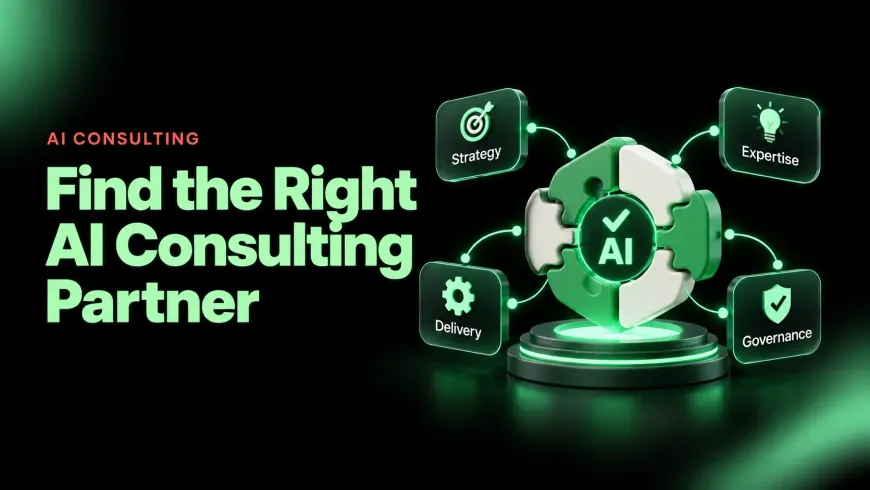
Knowing how to choose an AI consulting partner decides whether your AI budget produces working systems or a shelf of strategy decks. A good partner finds the few use cases worth funding, checks that your data and teams are ready, and leaves you with a roadmap someone can actually build. A poor one sells you the same generic plan it sold the last client.
Demand for this help is growing fast. The AI consulting and support services market was worth $14 billion in 2024 and is projected to reach $72.8 billion by 2030, according to ResearchAndMarkets. Yet Gartner predicted that at least 30% of generative AI projects would be abandoned after the proof of concept by the end of 2025, often because of poor data, unclear value, or rising costs. The consulting partner you pick is your best protection against joining that group.
This guide explains what an AI consulting partner should deliver, why an AI maturity assessment comes first, the eight criteria to compare partners on, the twelve questions to ask, the red flags to avoid, and how a strong engagement is structured. It reflects how EnactOn delivers AI consulting services: decisions grounded in your data, not in hype.
What Does an AI Consulting Partner Actually Do?
An AI consulting partner helps you decide where AI creates real business value, whether your organization is ready for it, and what to build first. The work covers use-case discovery, data readiness, build-versus-buy advice, risk and governance planning, and a delivery roadmap. The output should be a funded, prioritized plan, not a list of possibilities.
| Engagement type | What it covers | Typical duration |
|---|---|---|
| Opportunity assessment | Find and rank AI use cases by value and feasibility | 2 to 3 weeks |
| AI maturity and readiness assessment | Score data, infrastructure, skills, and governance | 2 to 4 weeks |
| Strategy and roadmap | Prioritized use cases, architecture direction, budget, timeline | 4 to 6 weeks |
| Proof of concept | Test the top use case on real data against a metric | 4 to 6 weeks |
| Governance and risk planning | Policies, controls, and accountability for AI use | 2 to 4 weeks |
When Does Your Business Need an AI Consulting Partner?
You need an AI consulting partner when AI decisions carry real budget or risk and your team lacks the experience to make them confidently. The clearest signs are below.
-
Too many ideas, no priorities. Teams are proposing AI projects but nobody can say which ones will pay back.
-
Pilots that never ship. Proofs of concept look promising but stall before reaching real users.
-
Unclear data readiness. Nobody knows whether your data is clean, accessible, or legally usable for AI.
-
Board or investor pressure. Leadership wants an AI plan with numbers, timelines, and risks.
-
Regulated or sensitive data. Healthcare, finance, or personal data adds compliance questions your team has not faced.
Companies rethinking their whole operating model around AI, as described in this guide to becoming an AI-first business, benefit most from outside help early.
Why Should an AI Maturity Assessment Come First?
An AI maturity assessment comes first because it shows what your organization can realistically build today and what must be fixed before AI can work. It scores your data, infrastructure, skills, processes, and governance, so the roadmap matches your starting point rather than an ideal one.
| Maturity level | What it looks like | Right next step |
|---|---|---|
| 1. Exploring | Interest in AI, no projects or data strategy | Opportunity assessment and data audit |
| 2. Experimenting | Isolated pilots and personal AI tool use | Prioritize use cases and set governance basics |
| 3. Operationalizing | One or two AI systems in production | Standardize data pipelines, evaluation, and monitoring |
| 4. Scaling | AI in several functions with shared platforms | Build reusable components and an AI operating model |
| 5. Transforming | AI shapes products, processes, and strategy | Continuous optimization and new AI-driven offerings |
A strong AI maturity assessment partner scores each dimension with evidence, such as data samples and system reviews, rather than interviews alone. The result should tell you exactly which gaps block your top use cases.
How Do You Choose an AI Consulting Partner?
To decide how to choose an AI consulting partner, compare candidates on eight criteria: business framing, maturity assessment method, delivery capability, industry experience, governance practice, independence, team seniority, and pricing transparency. Score each one on evidence, not on the pitch.
1. Business Framing Before Technology
The partner should start from your goals, costs, and customers, then work back to AI. Ask them to explain how they would measure value for your top use case before naming a single model or tool.
2. A Clear Maturity Assessment Method
A credible AI maturity assessment partner can show you its scoring framework, the evidence it collects, and a sample report. Avoid partners whose assessment is a short survey followed by a generic slide.
3. Ability to Deliver, Not Just Advise
Roadmaps fail when the people who write them have never built what they recommend. Prefer partners who can also deliver, or at least prove their plans reached production, such as an AI automation workflow running in a real business.
4. Relevant Industry Experience
Industry experience shortens discovery and surfaces regulatory issues early. Ask for projects in your sector or with similar data, customers, and compliance rules.
5. Governance and Responsible AI Practice
Look for a defined approach to risk, such as the NIST AI Risk Management Framework, plus human review of AI decisions and clear accountability. Governance should be part of the roadmap, not an afterthought.
6. Independence From Vendors
Ask whether the partner earns commissions or referral fees from software or cloud vendors. Independent advice matters most when you are deciding between building, buying, or combining both.
7. Senior People Doing the Work
Confirm who will run your assessment and roadmap, and how much of their time you will get. Senior practitioners spot data and integration problems that junior analysts miss.
8. Transparent Pricing and Scope
Expect a fixed scope and price for discovery phases, published rates, and a clear statement of deliverables. Open-ended consulting retainers without defined outputs rarely produce decisions.
Start With an AI Opportunity Assessment EnactOn reviews your goals, data, and systems, then ranks the AI use cases worth funding, with costs and timelines your team can act on. Book a Free Discovery Session →
Should You Hire an AI Consultancy Agency or an Independent Consultant?
Hire an independent consultant for focused advice on a narrow question, and an agency when you need assessment, strategy, and delivery capacity together. When working out how to choose an AI consultancy agency, check that the agency can staff data engineering, architecture, and governance, not only strategy.
| Factor | Independent consultant | AI consultancy agency |
|---|---|---|
| Best for | Second opinions, narrow questions, coaching | Assessments, roadmaps, and delivery |
| Capacity | One person’s time and skills | Multi-disciplinary team |
| Continuity | Depends on one individual | Backed by a team and processes |
| Cost | Lower total, higher risk of gaps | Higher total, broader coverage |
| Path to build | Usually hands off to another vendor | Can often build what it recommends |
To see how established agencies compare on ratings, pricing, and specialization, review this list of top AI consulting firms.
What Questions Should You Ask an AI Consulting Partner?
These twelve questions are the practical side of how to choose an AI consulting partner. Ask every candidate the same set and compare the specificity of their answers.
-
Which of your recommendations are running in production today? Ask for usage data and the business result.
-
How do you assess AI maturity? Request the framework and a sample report.
-
How do you prioritize use cases? Look for scoring on value, feasibility, data readiness, and risk.
-
When have you told a client not to use AI? Good partners can name examples.
-
What will you need from our team? Clarify time, data access, and decision-makers.
-
Who will do the work? Get names, roles, and time allocation.
-
How do you handle sensitive or regulated data? Check security practices and compliance experience.
-
Do you receive fees from any vendors you recommend? Confirm independence in writing.
-
What exactly will we receive at the end? Expect a prioritized roadmap with budgets, timelines, and owners.
-
Can you build what you recommend? Ask how strategy hands over to delivery.
-
How do you measure the success of your consulting? Look for decisions made and outcomes reached, not hours billed.
-
What does each phase cost? Get fixed prices for defined phases.
What Red Flags Signal the Wrong AI Consulting Partner?
Knowing how to choose an AI consulting partner also means knowing which ones to rule out. The clearest red flags are a generic playbook, no production references, and a recommendation that every idea needs AI. Watch for the patterns below during your evaluation.
| Red flag | Why it matters |
|---|---|
| Same roadmap template for every client | Your data, market, and constraints are ignored |
| No proof that past plans were built | Recommendations may not survive real delivery |
| Tool or vendor chosen before discovery | Suggests commissions or a fixed agenda |
| No data review in the assessment | Readiness claims are guesses |
| Open-ended retainer with no deliverables | Costs grow without decisions |
| Governance mentioned only at the end | Risk and compliance gaps appear late and expensively |
How Should an AI Consulting Engagement Be Structured?
A strong AI consulting engagement runs in four phases: align on goals, review opportunities and data, validate the top priorities, and hand over a roadmap. Each phase should end with a decision, so you can stop or continue with confidence.
| Phase | Key activities | Decision at the end |
|---|---|---|
| 1. Goal alignment | Stakeholder interviews, success metrics, constraints | Which outcomes matter most |
| 2. Opportunity and data review | Use-case discovery, maturity scoring, data checks | Which use cases are feasible |
| 3. Validation | Feasibility tests or a proof of concept | Which use cases to fund |
| 4. Roadmap and handover | Architecture direction, budget, timeline, owners | Build plan and partner choice |
The best roadmaps connect AI to the wider operation, including systems, processes, and people. A structured AI adoption roadmap turns those decisions into a step-by-step rollout plan. Once the roadmap is approved, our guide on how to choose an AI development partner covers selecting the team that will build it.
How Does EnactOn Approach AI Consulting?
EnactOn approaches AI consulting as the first step toward a working system. Engagements cover use-case discovery, data readiness, build-versus-buy advice, feasibility testing, governance planning, and a delivery roadmap, with risk planning aligned to the NIST AI Risk Management Framework.
-
Fast decisions. An opportunity assessment takes about 2 to 3 weeks, and a full strategy and roadmap takes 4 to 6 weeks.
-
Strategy that can be built. The same in-house team that writes the roadmap can deliver it, using Intent-Driven Engineering with human review at every step.
-
Transparent entry point. Projects start at USD 5,000 with a defined scope and deliverables.
-
Verified client feedback. EnactOn holds a 4.8/5 rating on Clutch.
Conclusion
The right AI consulting partner shortens the path from ideas to funded, buildable priorities. It starts with an honest view of your maturity, ranks use cases on evidence, and leaves you with a roadmap tied to budgets, owners, and measurable outcomes.
Use the eight criteria and twelve questions in this guide to compare two or three partners side by side, and insist on a fixed-scope first phase. That is how to choose an AI consulting partner whose advice ends up in production rather than in a slide deck.
EnactOn brings 13+ years of delivery experience, 500+ projects for 350+ clients in 65+ countries, a 4.8/5 rating on Clutch, and a 95% client retention rate. Its 80+ in-house engineers, designers, and QA professionals carry AI strategy through to production.
FAQs
What does an AI consulting partner do?
An AI consulting partner identifies where AI can create value, assesses whether your data and teams are ready, and builds a prioritized roadmap. Many also validate top use cases with a proof of concept and advise on governance. The goal is a clear, funded plan your organization can execute.
How much does an AI consulting engagement cost?
Costs depend on scope and partner. Focused assessments and roadmaps often start around USD 5,000 to 15,000, while larger strategy programs cost more. Ask for fixed prices per phase so costs stay tied to deliverables.
How long does an AI consulting engagement take?
An opportunity assessment typically takes 2 to 3 weeks, and a full strategy and roadmap takes 4 to 6 weeks. Adding a proof of concept extends the engagement by several weeks. Larger organizations with many business units may need longer.
What is an AI maturity assessment?
An AI maturity assessment scores your organization’s readiness for AI across data, infrastructure, skills, processes, and governance. It shows where you stand today and which gaps block your highest-value use cases. The results shape a realistic roadmap.
How do I choose an AI consultancy agency over a freelancer?
Knowing how to choose an AI consultancy agency over a freelancer comes down to scope. Choose an agency when you need assessment, strategy, and delivery capacity together, or when continuity matters. A freelancer works well for narrow questions or second opinions.
What is the difference between AI consulting and AI development?
AI consulting decides what to build and why, covering use cases, readiness, ROI, and risk. AI development builds, deploys, and maintains the systems. Partners who do both reduce the risk of plans that cannot be built.
Do small businesses need an AI consulting partner?
Not always. A small business with one clear use case can often go straight to a proof of concept with a capable development partner. Consulting helps most when there are many competing ideas, sensitive data, or significant budget at stake.
What should an AI roadmap include?
An AI roadmap should include prioritized use cases, success metrics, data and infrastructure requirements, architecture direction, budgets, timelines, owners, and governance controls. Each item should be specific enough for a delivery team to estimate and build.
How do I measure the value of AI consulting?
Measure consulting by the decisions it enables and the outcomes that follow. Useful signals include use cases funded or rejected with clear reasons, time to first production system, and measurable results against the metrics set during discovery.
Should my AI consulting partner also build the solution?
It often helps. A partner who can also build will write roadmaps grounded in real delivery constraints, and you avoid knowledge loss between strategy and engineering teams. If you use separate firms, require detailed handover documentation.
How does EnactOn deliver AI consulting?
EnactOn runs a four-phase engagement: goal alignment, opportunity and data review, validation, and roadmap handover. An opportunity assessment takes about 2 to 3 weeks, projects start at USD 5,000, and EnactOn holds a 4.8/5 rating on Clutch. The same in-house team can then build what the roadmap recommends.